
logistics · 2024 · a MENA logistics company
Digital transformation for a regional logistics operator
Replaced a six-spreadsheet ops workflow with a multi-tenant web platform: dispatch, driver app, customer tracking, billing, all one source of truth.
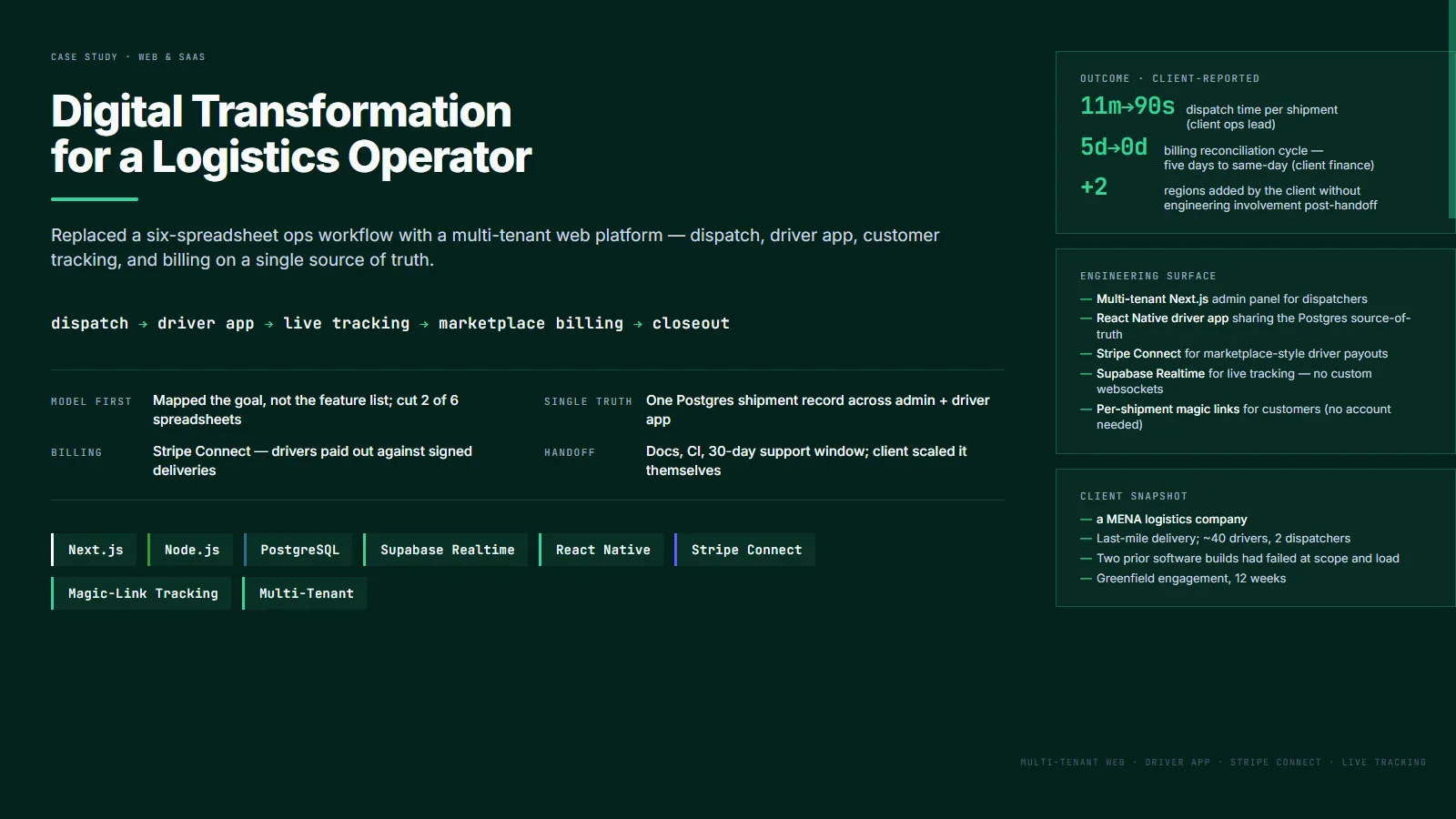
- 11min → 90s dispatch time per shipment client ops lead
- 5d → same-day billing reconciliation cycle client finance
- 2 regions added by client without engineering involvement (post-handoff, 6 months) client ops lead
Context
A regional logistics operator with ~40 drivers, two dispatchers, and a fleet of spreadsheets that no two people read the same way. They had attempted two prior software builds: one died at scope, the other shipped but couldn’t handle peak load on Mondays.
Problem
The honest story was that the spreadsheets weren’t the problem; the workflow was. Each previous build had digitised the spreadsheet without questioning the underlying ops, and the result was a slower spreadsheet.
Approach
The team mapped the goal, not the feature list, then proposed cutting two of the six spreadsheets entirely (the duplicates) and merging the customer-facing one into the driver app via a shared shipment record. Lean scope, signed off in week one, no surprises at week six.
Solution
- Multi-tenant Next.js admin panel for dispatch + a React Native driver app sharing a single Postgres source-of-truth.
- Stripe Connect for marketplace billing: drivers paid out automatically against signed off-deliveries.
- Live tracking page customers received as a per-shipment magic link (no account needed).
- Real-time updates over Supabase Realtime, no custom websocket layer.
- Clean handoff with docs, CI on Vercel + GitHub Actions, and a 30-day support window.
Outcome
Above. Six months later the company added two regions to the platform without engineering involvement. That was the proof the underlying schema was right.
Have a similar project?
Send a short brief. We'll reply within one business day.
Start a project