
fintech · 2025 · DatVerse engineering portfolio
Options trading automation bot — rule-based execution engine
Rule-based options trading automation bot with a deterministic execution engine, backtest harness, and risk controls.
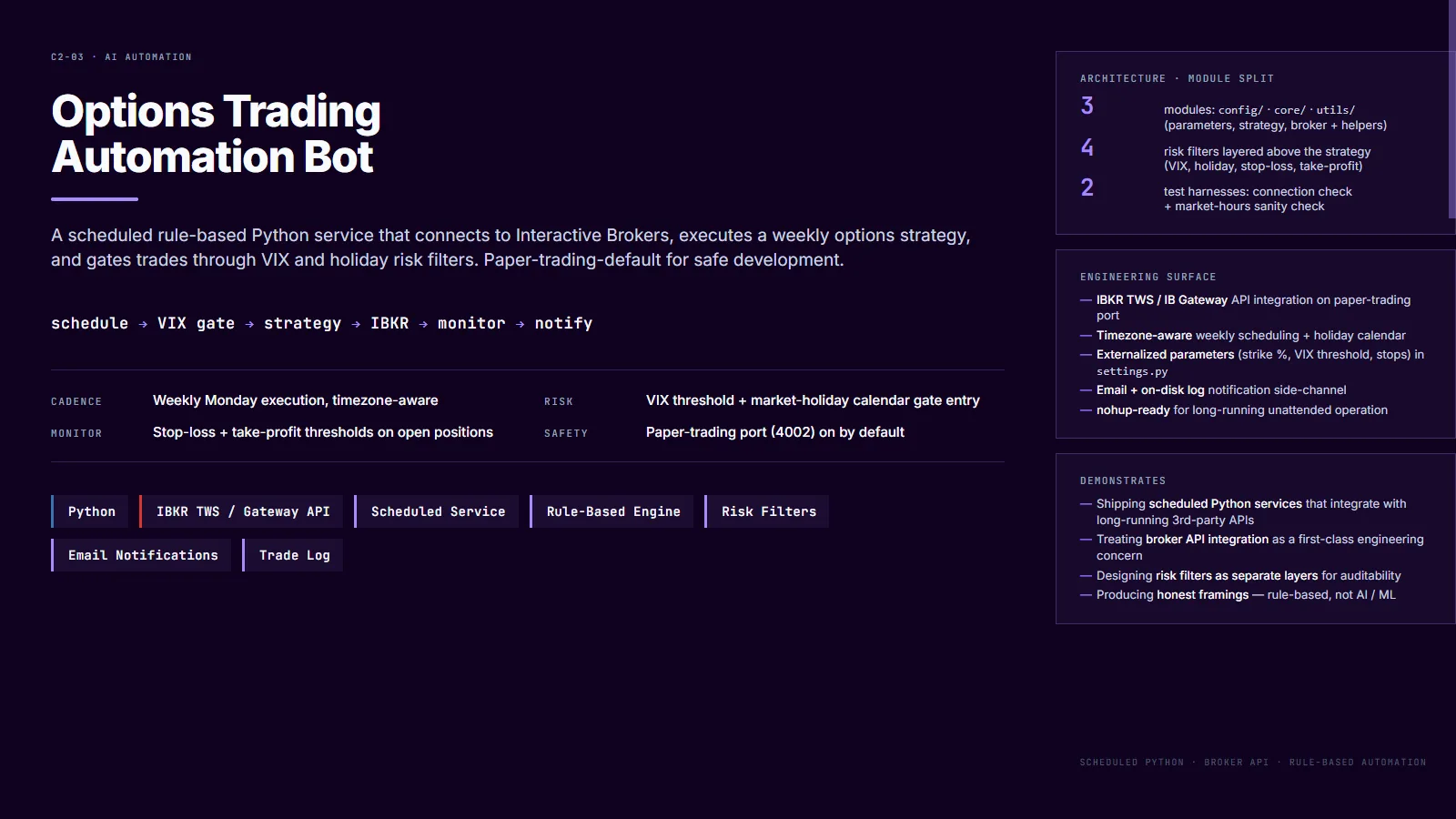
- Rule-based deterministic execution with backtest harness for new-rule validation architectural record
Context
Options trading automation lives in the space between strict rule-based execution and discretionary trader judgment. The build is a deliberate counterexample to the “throw an LLM at it” pattern: a deterministic rule engine where every execution path is auditable.
Problem
LLM-driven trading bots are interesting research but bad operating reality. They fail in ways that aren’t reproducible, and risk controls have to be bolted on around them. A rule-based engine inverts that: rules are explicit, backtestable, and reviewable.
Approach
A Python rule engine with backtest harness as a first-class subsystem: every new rule passes through the backtest before it gets a live-execution path. Risk controls (position size, daily loss caps, instrument filters) sit at the engine level, not as ad-hoc per-rule checks.
Solution
- Python rule engine with deterministic execution paths.
- Backtest harness for validating new rules against historical data before live deployment.
- Configurable risk controls (position size, daily loss caps, instrument filters) at the engine layer.
- Audit log of every execution decision for post-trade review.
Outcome
Above. The rule-based posture is the methodology contribution; deterministic execution and backtest-first validation are the operating discipline.
Have a similar project?
Send a short brief. We'll reply within one business day.
Start a project